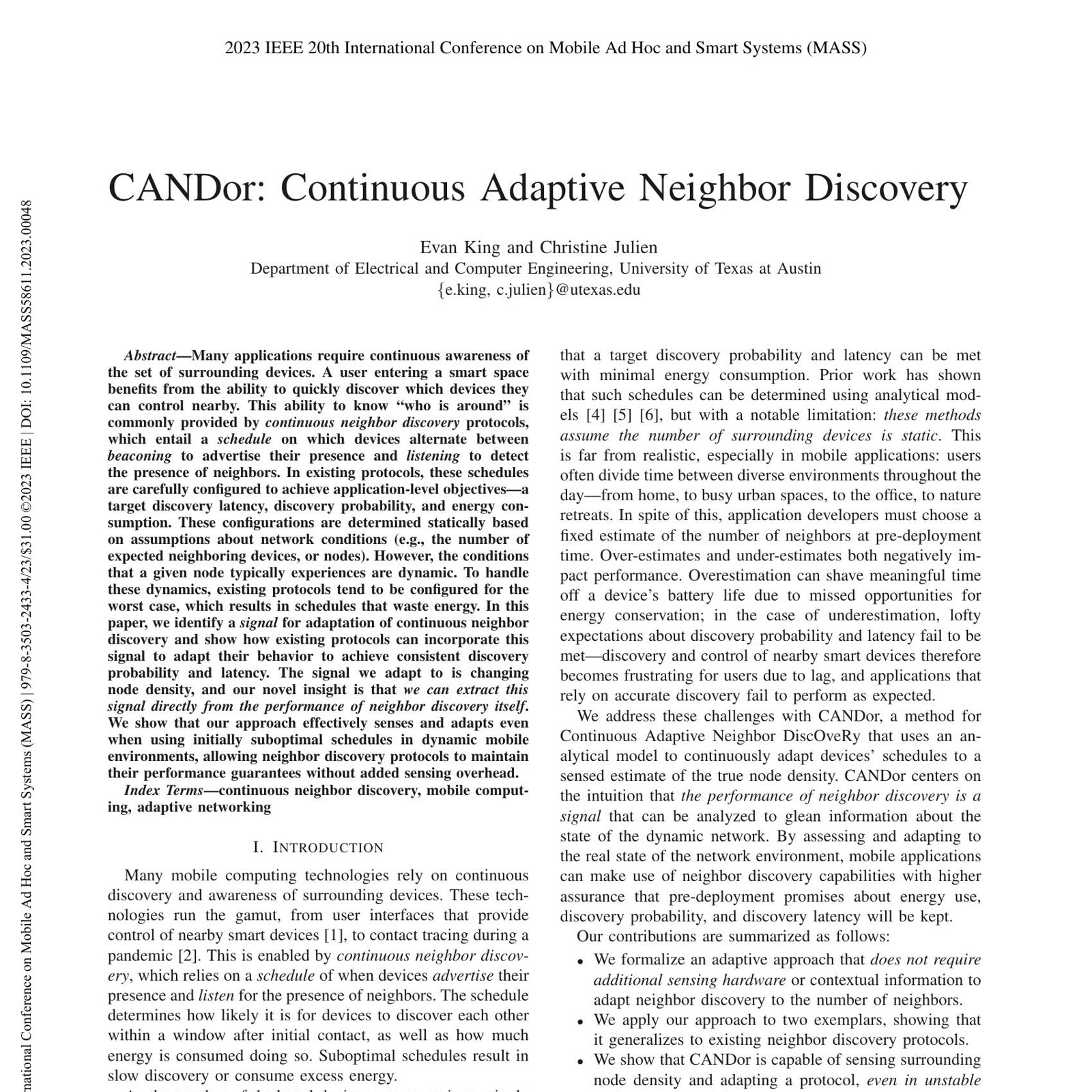
CANDor: Energy efficient neighbor discovery
Bluetooth Low Energy (BLE) can be useful for forming ad-hoc networks between smart devices, and for exchanging information in sensor networks. It’s difficult, however, to choose the right settings for the BLE protocols that devices use to discover one another. The optimal protocol effectively balances discovery latency and packet reception rates with the energy consumed by sending and scanning for neighboring packets.
In this work, I introduce a novel neighbor discovery protocol to improve the packet reception rate and energy consumption of BLE neighbor discovery. Unlike prior work, which uses extra sensors (e.g., GPS) to recalibrate the protocol performance, this work uses the performance of neighbor discovery itself as a signal to determine when to recalibrate the protocol’s settings.
Part of this work involved implementing a large-scale mobile neighbor discovery simulator in Python. In it, I implemented the proposed CANDor protocol alongside other canonical neighbor discovery protocols (Birthday and BLEnd). Using the simulator, I showed that CANDor outperformed prior work, delivering superior packet reception rates and energy balancing characteristics during mobility.
This work was supported by a grant from the National Science Foundation. You can read the full text in the NSF archive.